Banco Falabella — Lía Chatbot
Designing a conversational assistant that turned complex financial services into guided, scalable interactions.
I helped Banco Falabella design and train Lía, a conversational assistant for banking, CMR, travel, and insurance services. I built conversational flows, intents, and guided templates that improved the chatbot's ability to answer on its own.
Company
Banco Falabella Colombia
Industry
Finance / Retail banking
Role
UX Specialist / UX Designer
Product type
Conversational assistant / Chatbot
Timeline
Mar 2017 – Aug 2019
Team
UX, Product, Business Stakeholders, Development, Chatbot/NLP, Content
Methods
Conversational UX, IA, Intent Design, Flow Mapping, Templates, Training, Validation
Tools
Sketch, Zeplin, Balsamiq, DialogFlow, Adobe XD, Adobe Creative Cloud
Status
Launched
Confidentiality
Part of this project is under NDA: sensitive conversation flows, business rules, and internal logic are simplified. I'm happy to share more detail in an interview or portfolio review.
Context
Banco Falabella needed a conversational channel for four financial businesses: Banco, CMR, Viajes, and Seguros. Each line had different services and expectations, but customers needed one simple, friendly assistant.
The hard part wasn't writing good responses; it was building a structure that guided users and helped the assistant answer accurately across very different kinds of requests.
Why it mattered
Financial services get confusing very quickly when users have to explain everything in their own words. Lía needed strong information architecture, controlled paths, and a friendly tone so people could move forward without getting lost.
My role
I worked as UX Specialist with a Conversational UX focus: I structured the assistant's logic, defined guided flows, trained intents, and helped create a methodology for improving the chatbot over time.
- Designed conversational flows for banking, CMR, travel, and insurance use cases.
- Structured intents, templates, and guided interaction patterns.
- Helped train Lía by identifying what information the chatbot needed and what could create confusion.
- Worked with business stakeholders to understand services and expected requests.
- Designed visual assets and interface components for the chatbot's UI.
The challenge
The main challenge was designing a chatbot that could support multiple financial services without overwhelming users or breaking the assistant's response quality.
- User challenge: users needed quick answers, but open-ended questions led to confusion and dead ends.
- Business challenge: one assistant had to serve four business lines with a consistent experience.
- Design challenge: overtraining created poor responses, so the experience needed clear structure and well-organized intents.
Problem statement
How might we serve banking, CMR, travel, and insurance through one friendly assistant, while keeping the conversation structured enough for the chatbot to respond accurately?
Goals & success criteria
User goals
- Help users find answers without navigating multiple channels.
- Reduce confusion caused by open-ended chatbot interactions.
Business goals
- Support multiple business lines through one conversational assistant.
- Increase the chatbot's ability to resolve inquiries and transactions autonomously.
Design goals
- Define clear conversational flows and intent structures.
- Use guided templates to reduce ambiguity.
- Improve chatbot training through better information architecture.
Process
01 — Discover
Understanding how users ask for help in each financial service
I first understood the business lines and the kind of support users needed from each one: where conversations became ambiguous and which topics needed controlled flows instead of open-ended questions.
- Identified recurring requests, inquiries, and transactional needs.
- Mapped where open-ended conversations could create misunderstanding.
- Analyzed how information should be grouped to make the chatbot easier to train and easier to use.
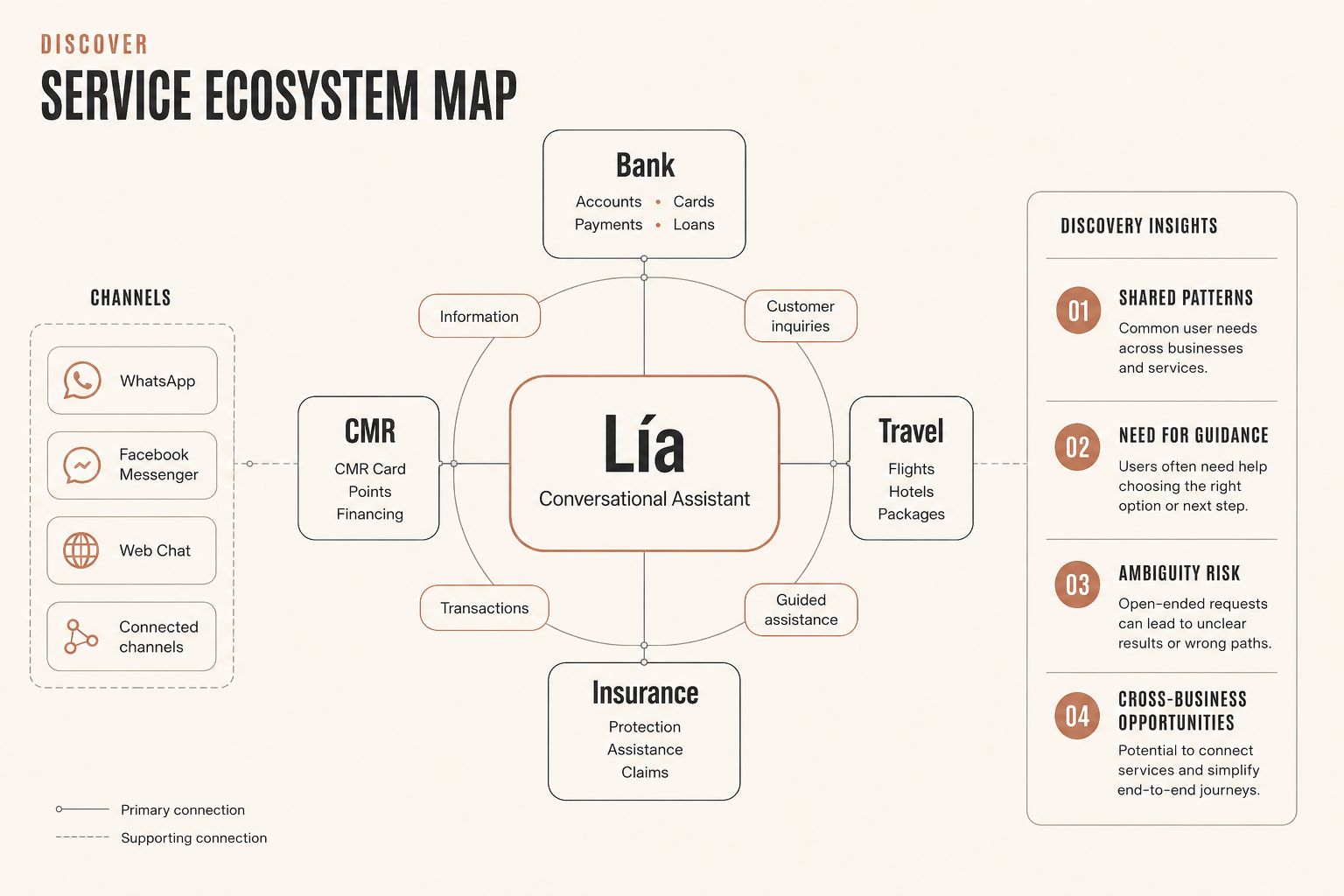
Early discovery structure used to understand how different financial services could live inside one conversational assistant.
02 — Define
Turning scattered services into a conversational architecture
Then I defined the structure behind the assistant: organizing intents, deciding when to use templates, and shaping a model where users choose options instead of describing everything from scratch.
- Grouped intents by business line, user need, and expected outcome.
- Defined guided paths for frequent inquiries and transactions.
- Helped define how Lía should behave when she did not understand a request.
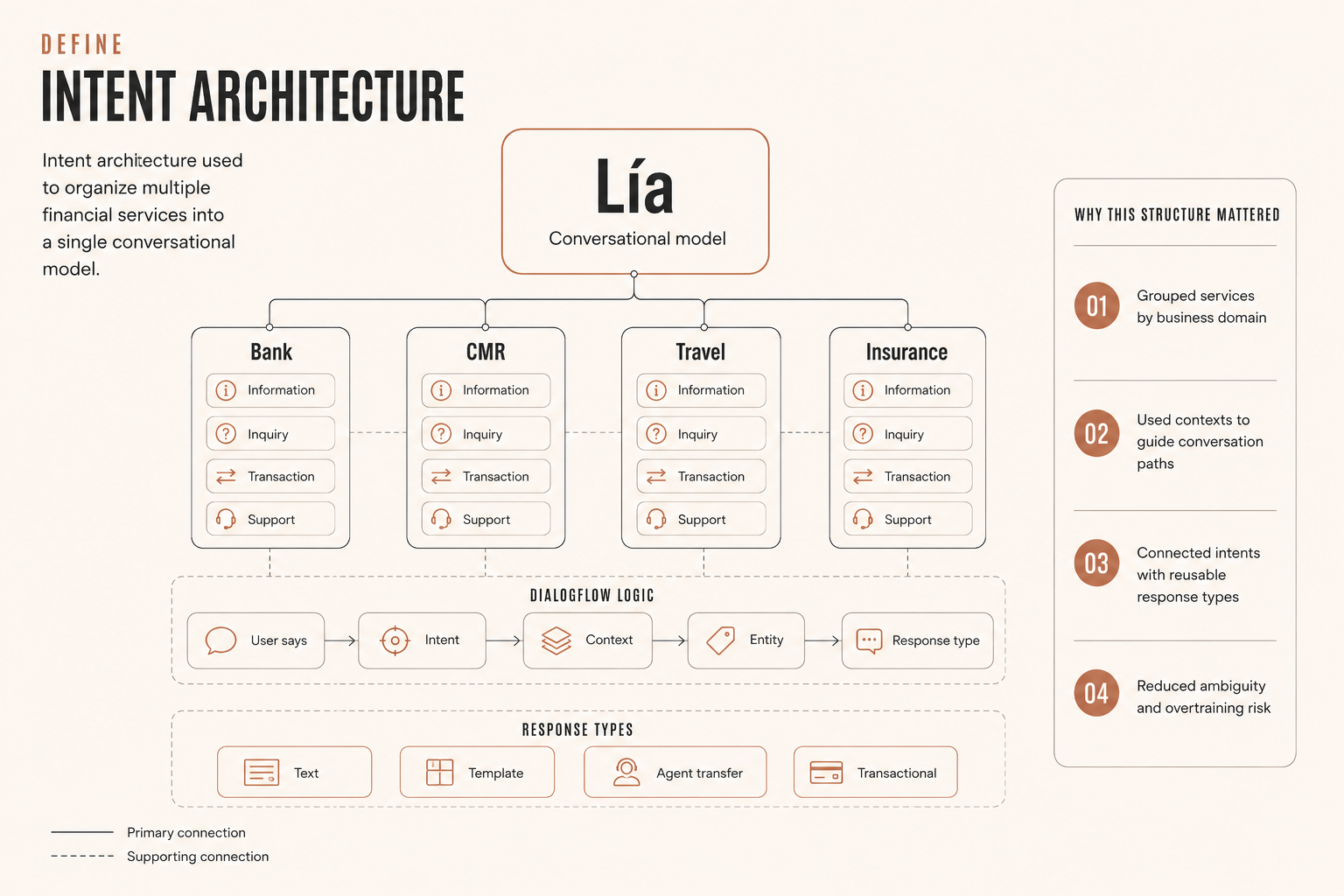
Intent architecture used to organize multiple financial services into a single conversational model.
03 — Develop
Designing guided flows instead of fully open conversations
The most important decision was not to treat the chatbot as a fully open question-and-answer system: too much freedom made the experience less reliable. Guided flows and templates reduced the risk of wrong answers. We decided where to go next as an innovation team: several developers, 2 data scientists, 1 administrative person, the innovation lead, and me.
- Designed conversational flows for key use cases.
- Created guided templates to help users choose the right path.
- Adjusted flows when training results showed confusion or wrong responses.
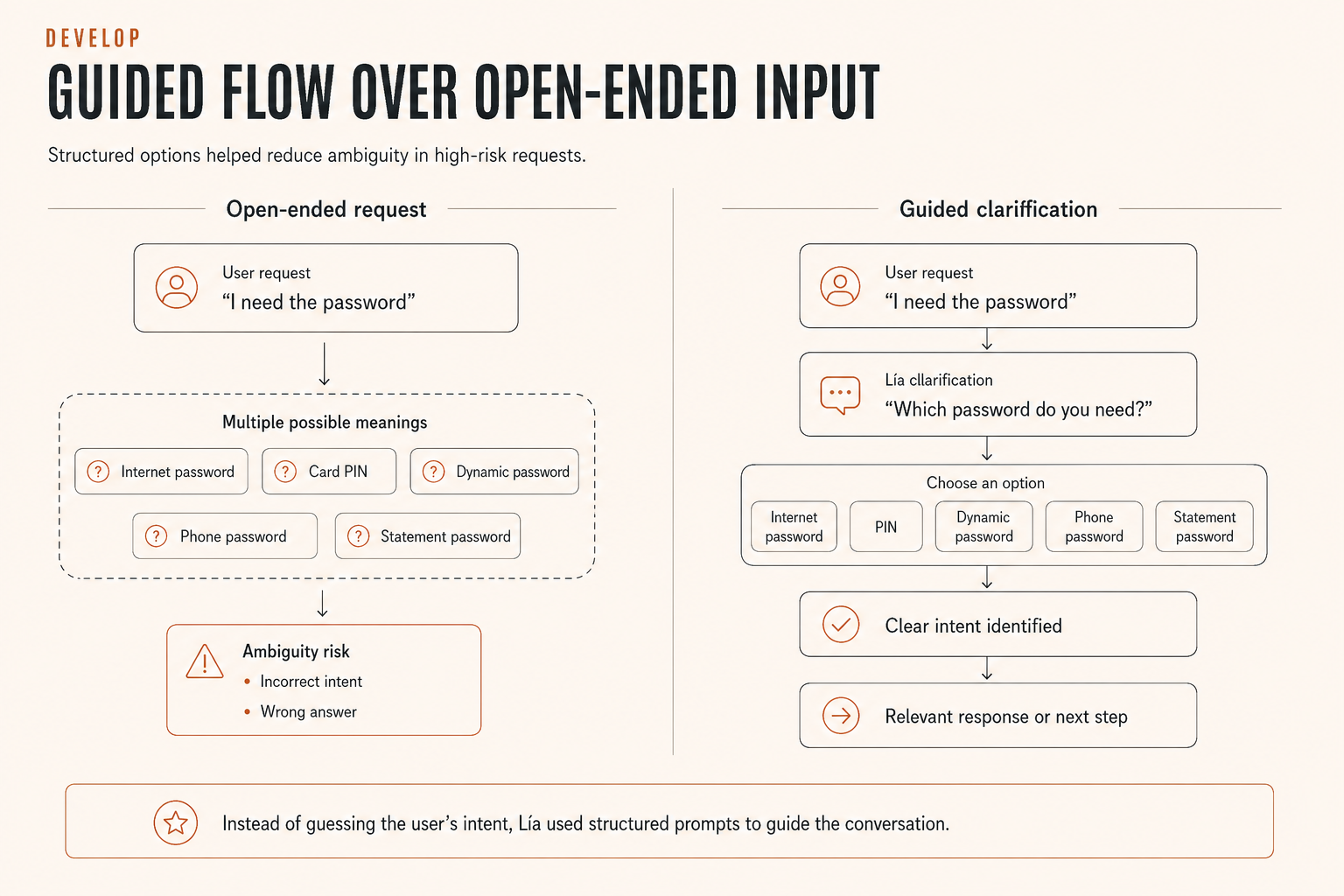
Guided flow example showing how structured options reduced ambiguity compared with open-ended questions.
04 — Deliver
Launching a friendlier, more scalable assistant
The result was an assistant that could serve several financial businesses with a friendly, structured experience, designed to improve over time through more intentional training.
- Delivered conversational flows, templates, and intent structures.
- Improved the quality of interactions by reducing overtraining and ambiguous inputs.
- Built a reusable Conversational UX foundation for future improvements.
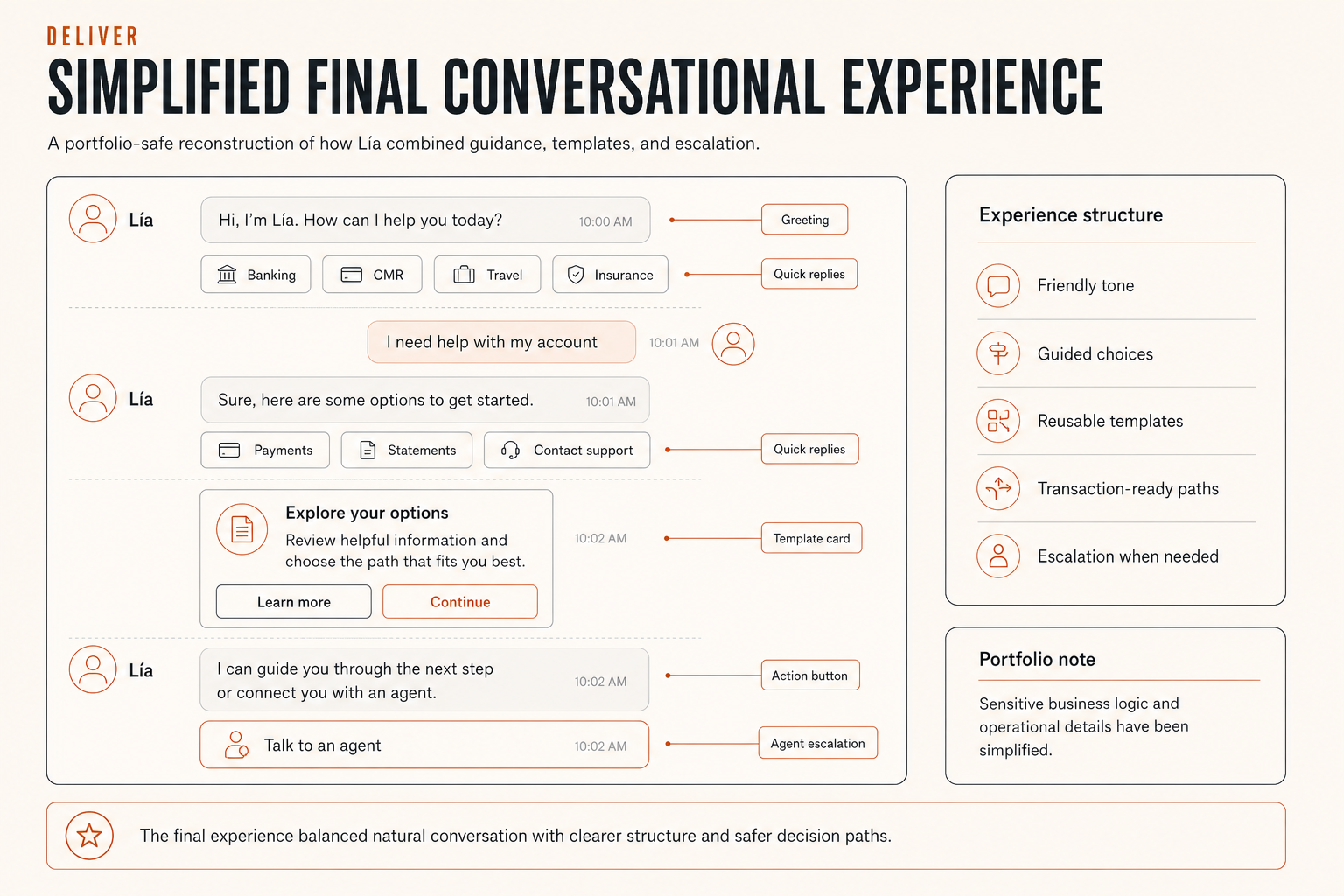
Final conversational experience simplified for portfolio purposes to show structure without exposing sensitive business logic.
Before / after
Before
Open-ended inputs and overloaded training made the chatbot respond incorrectly or create confusing interactions.
After
Lía served Banco, CMR, Viajes, and Seguros with clear flows, guided templates, and structured intents.
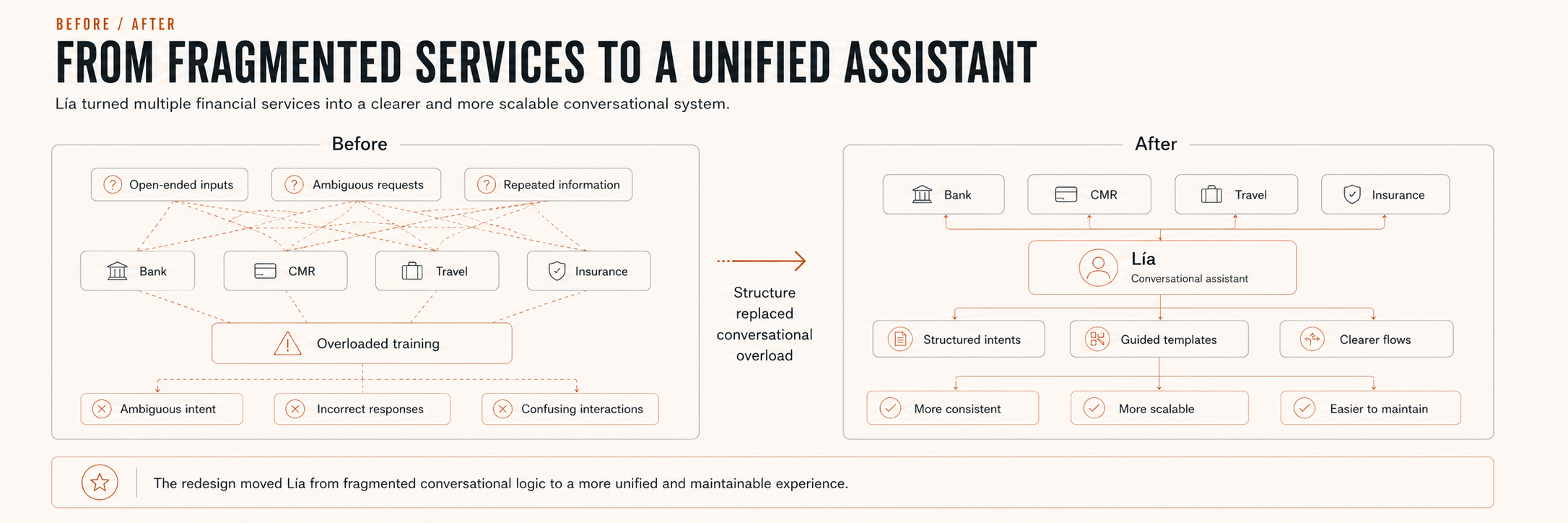
Before-and-after comparison of the conversational model, showing how structured paths replaced the open-ended input that produced failed responses.
Final solution
The proposal focused on three improvements:
A guided conversational model
Instead of relying only on open-ended questions, Lía used templates and structured paths to help users move forward with less confusion.
A scalable intent architecture
The assistant was organized by business line, user need, and expected outcome, which made it easier to train and evolve.
A friendlier financial assistant
Lía was designed to feel approachable and helpful, and make financial support less intimidating.
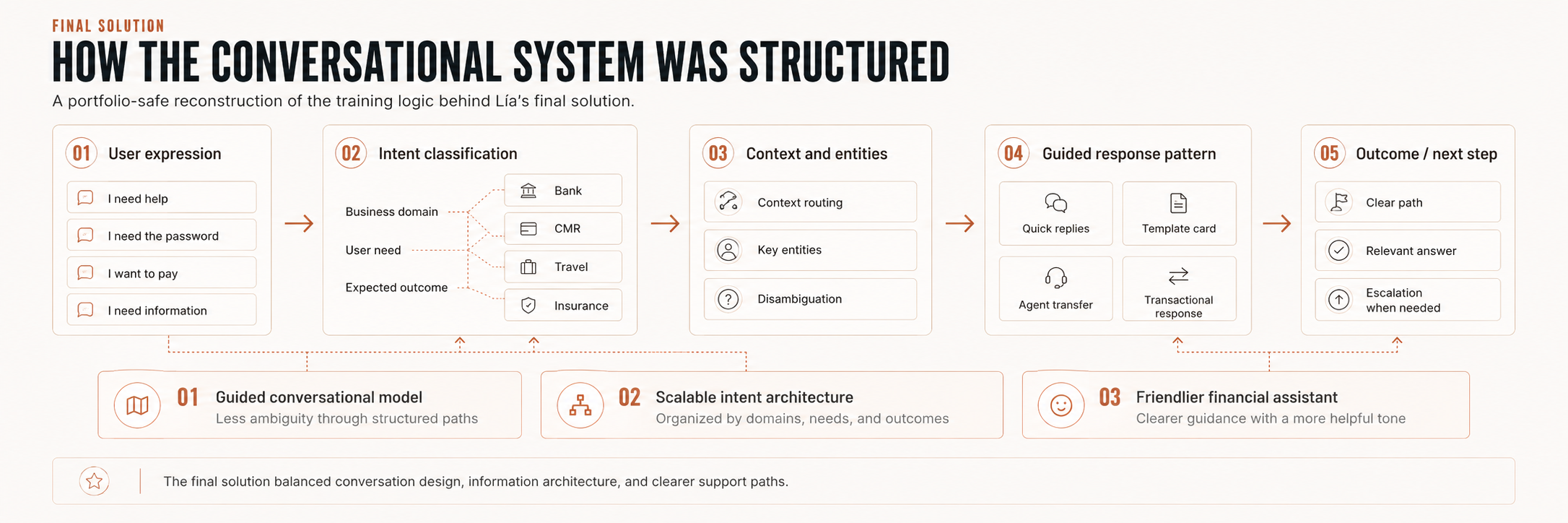
Summary of the final solution, where the three pillars — guided flow, intent architecture, and a friendlier tone — operate within a single conversation.
Impact & results
User value
Support across four financial services through one guided assistant.
Business value
One shared conversational structure for Banco, CMR, Viajes, and Seguros.
Product value
The chatbot achieved a 70% autonomous success rate in customer inquiries and in completing financial transactions.
Team / process value
A solid foundation for chatbot training and intent organization.
Obstacles & trade-offs
The balance was between user freedom, business coverage, and chatbot reliability, in a regulated environment that required coordinating every flow with legal and compliance. The strong solution was structuring the experience better, not adding more content.
- Avoiding overtraining while still covering multiple business needs.
- Balancing guided templates with the user's expectation of natural conversation.
- Maintaining a friendly tone while handling financial information.
What I learned
This project shaped the way I think about UX, well beyond chatbots: structure is what allows a product to scale.
- Information architecture is critical in conversational experiences.
- Overtraining a chatbot can make the experience worse, not better.
- Guided flows can create more confidence than fully open input.
Lía is where I learned to turn complexity into structure, and it's stuck with me since. A good conversational experience is built by designing the right paths and just enough guidance for users to get where they're going, not by adding more answers.
Stephanie Cacheo — Senior Product Designer / UX Lead