Telecom Personal Flow
Leading UX across a complex digital transformation, connecting teams, processes, and product decisions at scale.
I led UX work within Telecom Personal Flow's digital transformation program, coordinating designers across multiple product cells. I focused on improving alignment, delivery planning, and team onboarding across the Mi Personal Flow ecosystem.
Company
Telecom Personal Flow
Industry
Telecommunications / Digital transformation
Role
UX Lead Designer
Product type
Mobile app / Self-management & e-commerce ecosystem
Timeline
Oct 2021 – Feb 2024
Team
UX/Content Designers, POs, Business, Technology, Telecom & Globant Leadership
Methods
UX Leadership, Design Operations, Agile Scrum, Discovery, User Flows, IA, Critiques, Estimation, Onboarding
Tools
Figma, FigJam, Miro, Jira, Confluence, Notion, Maze, Hotjar, Google Analytics, Qualtrics, Asana
Status
Launched milestone / Design leadership / Under NDA
Confidentiality
Part of this project is under NDA: sensitive screens, roadmap details, and internal documentation are blurred or simplified. I'm happy to share more detail in an interview or portfolio review.
Context
Telecom Personal Flow was part of a large digital transformation program in Argentina, focused on evolving digital self-management and e-commerce experiences across a complex product ecosystem.
I joined the account in the middle of organizational and brand change. Over time I moved into UX leadership across clusters like Self, Retention & Loyalty, and Upper Funnel, and later became a UX representative in the Mi Personal Flow Upgrade initiative.
Why it mattered
What mattered most was building alignment across cells, fixing how designers estimated and delivered work, and giving the UX practice enough structure to survive a constantly changing environment.
My role
I worked as UX Lead Designer, leading and supporting UX designers across multiple product cells. I combined leadership, process improvement, mentoring, and hands-on contribution to initiatives such as the Mi Personal Flow Upgrade.
- Led six UX designers distributed across five self-management cells.
- Coordinated UX work between Telecom and Globant designers.
- Supported the UX team's planning, estimation, and rituals.
- Built onboarding material so new designers could integrate more autonomously.
- Helped identify process gaps and propose ways of working that improved visibility and collaboration.
- Tracked NPS (Net Promoter Score), CSAT (Customer Satisfaction Score), and CES (Customer Effort Score) with Qualtrics. With the other design leads we defined the main metrics to review, and with the product leads we agreed on how to move forward as a team.
The challenge
The main challenge was leading UX in a large, changing digital ecosystem where multiple teams were working in parallel, roadmap clarity was limited, and individual design decisions could affect the global user experience.
- User challenge: users needed a clearer, more consistent self-management experience while the product evolved in several areas at once.
- Business challenge: Telecom needed to land the Mi Personal Flow launch while coordinating many teams and delivery commitments.
- Design challenge: the UX team needed better estimation, shared documentation, and a transversal view of the experience.
Problem statement
How might we help multiple UX teams deliver a more consistent self-management experience, while improving collaboration and planning across a complex transformation program?
Goals & success criteria
User goals
- Support a clearer and more consistent self-management experience.
- Reduce fragmentation across journeys designed by different cells.
Business goals
- Support the Mi Personal Flow launch milestone.
- Improve delivery predictability and UX coordination across cells.
Design goals
- Improve UX estimation, planning, and team rituals.
- Create reusable documentation and onboarding material.
- Connect individual design decisions with the broader ecosystem.
Process
01 — Discover
Understanding the ecosystem, the teams, and the delivery gaps
I started by understanding how the UX team was organized, how each cell worked, and where collaboration was breaking down. The challenge was not just the product, but the operating model around design: uneven experience levels, mismatched expectations, and a roadmap that was not always clear.
- Reviewed how designers were distributed across cells and product areas.
- Identified gaps in estimation, communication, documentation, and delivery visibility.
- Mapped dependencies between design, content, product, and technology.
- Identified onboarding pain points for new designers.
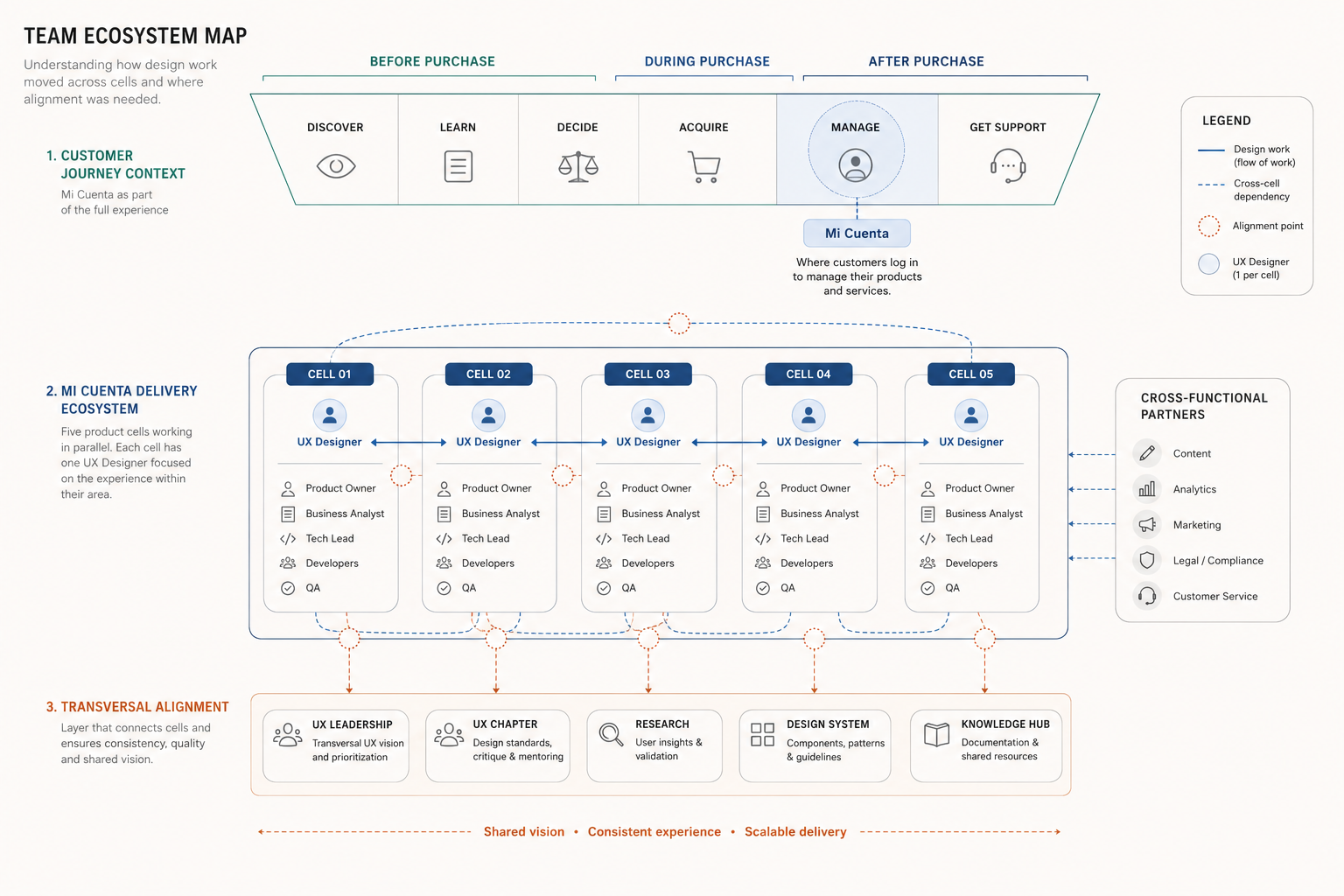
Team ecosystem map used to understand how design work moved across cells and where alignment was needed.
02 — Define
Creating a transversal UX direction across cells
After understanding the context, I focused on clearer ways of working: better estimation, stronger rituals, and documentation that connected each cell's work with the full experience.
- Defined improvement opportunities for UX planning, estimation, and rituals.
- Helped create alignment spaces between UX, content, product, and technology.
- Structured the onboarding material so new designers could access updated information on their own.
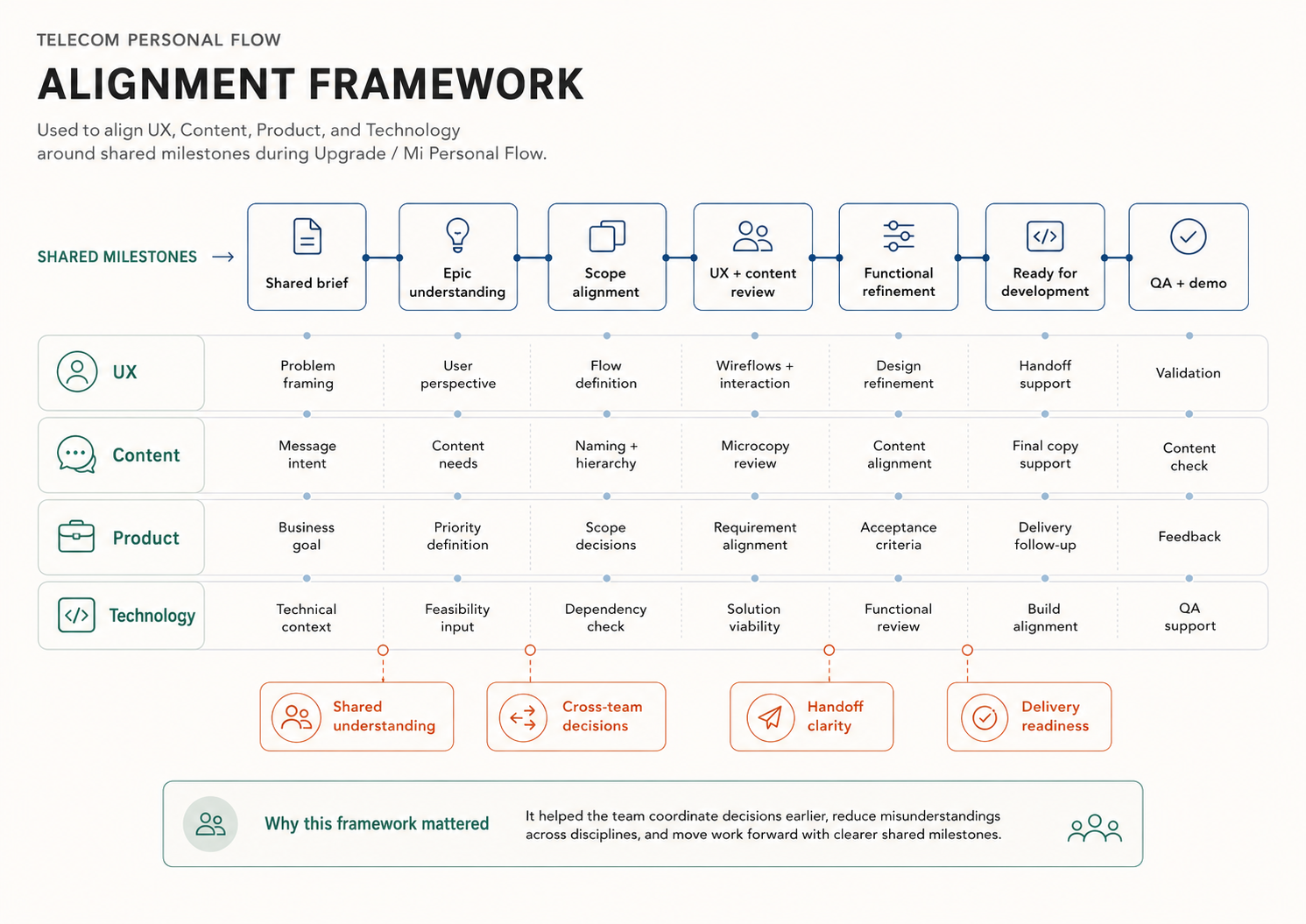
Alignment framework used to improve how UX, content, product, and technology collaborated around shared milestones.
03 — Develop
Improving processes, onboarding, and delivery consistency
With the gaps identified, I worked on practical improvements: less dependency on leaders for repeated explanations and better access to updated information.
- Improved estimation practices across UX designers and product cells.
- Created a self-service onboarding structure.
- Supported design critiques and feedback loops to improve delivery quality.
- Coordinated with Telecom and Globant designers to improve collaboration.
- We ran A/B tests on CTAs in e-commerce landing pages. The designer running the test and I, as their design lead, made the call.
- Worked with Hotjar (heatmaps and session recordings) and with the Google Analytics metrics dashboards (Mi cuenta, Ecommerce, and Goals).
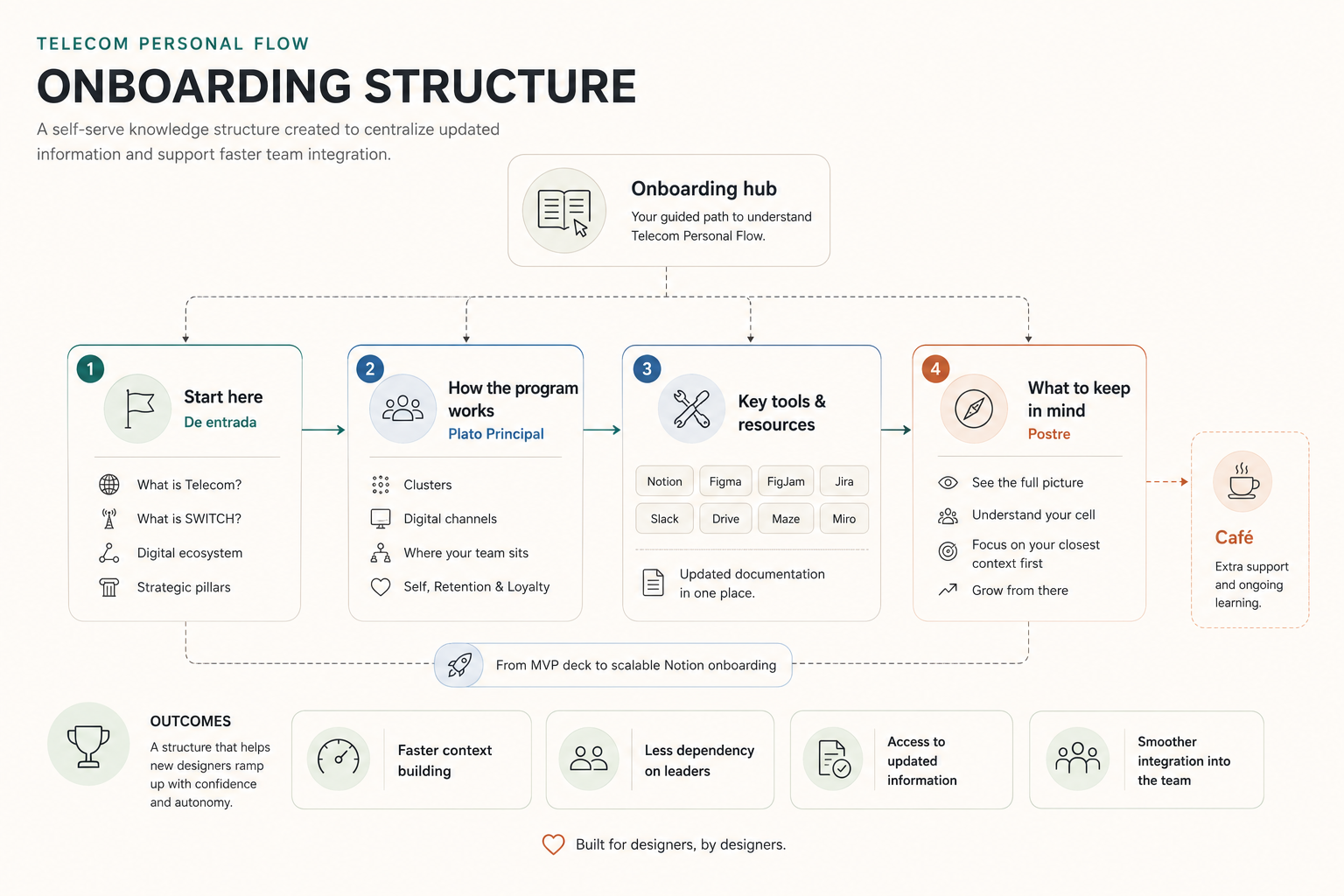
Onboarding structure created to help new designers access updated information and integrate with less dependency on leaders.
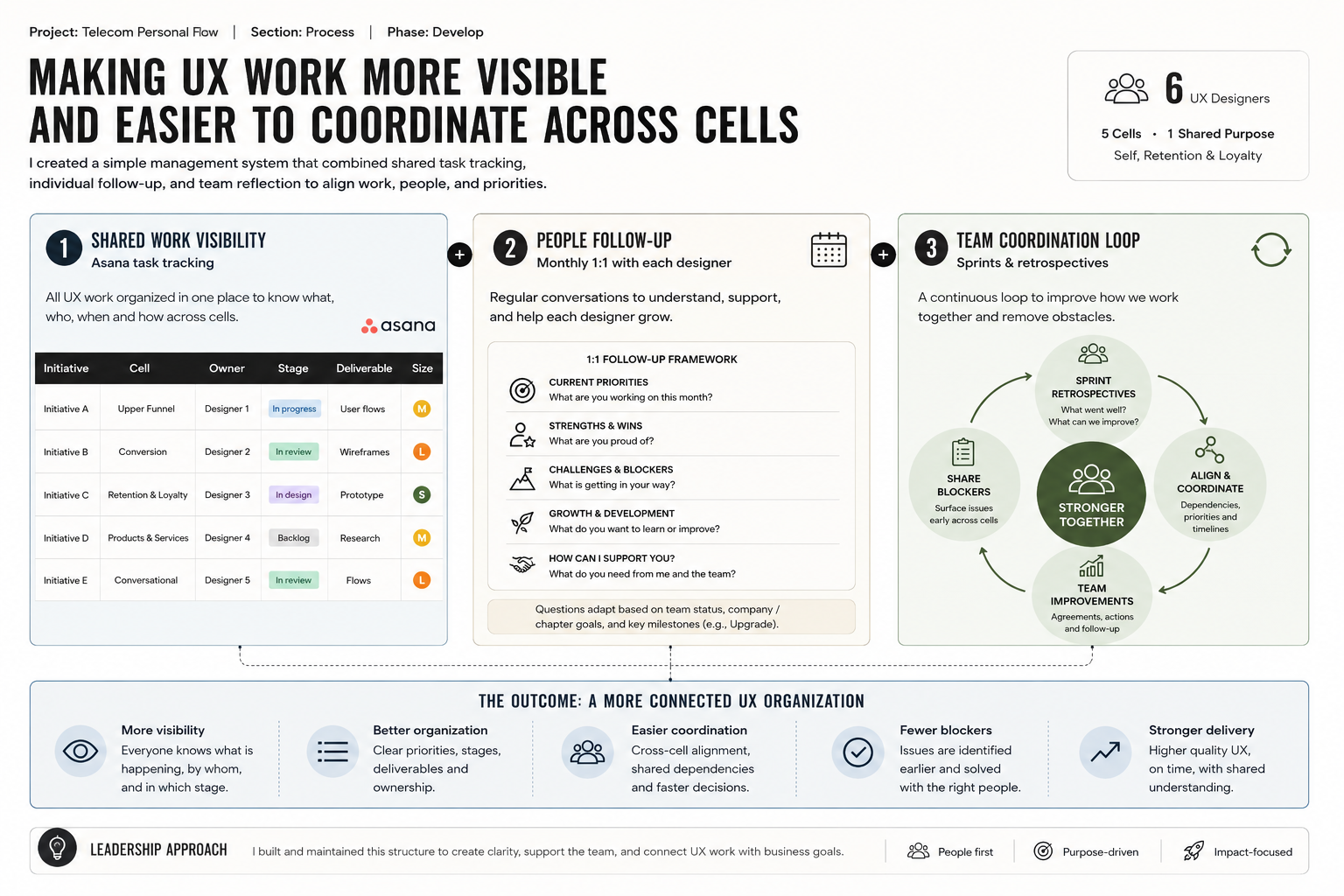
Process diagram showing how UX work became more visible, organized, and easier to coordinate across cells.
04 — Deliver
Supporting the Mi Personal Flow launch milestone
Despite the initial roadmap ambiguity, the UX team completed 100% of its deliverables for the Mi Personal Flow launch milestone.
- Improved UX estimation and delivery planning across multiple cells.
- Created onboarding material used by 10+ designers after joining the account.
- New designers integrated more autonomously, reaching out to leaders mainly for questions and follow-up.
- Contributed to the Upgrade initiative by promoting a transversal UX view across the ecosystem.
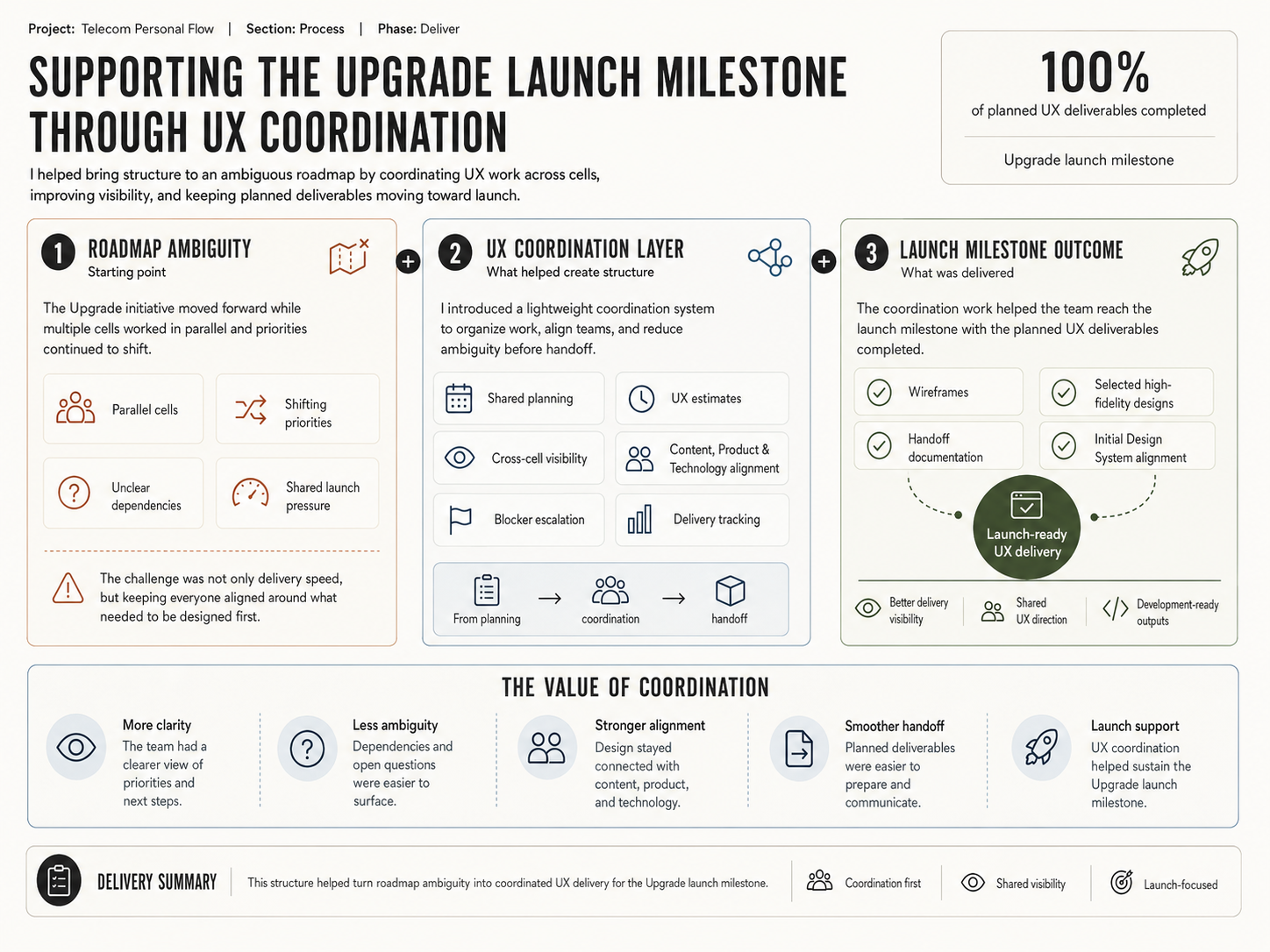
Delivery summary showing how UX coordination supported the launch milestone despite roadmap ambiguity.
Before / after
Before
Fragmented ways of working, inconsistent onboarding, and multiple teams designing in parallel under an ambiguous roadmap.
After
Stronger alignment rituals, better estimation, reusable onboarding, and a transversal view of the Mi Personal Flow experience.
Final solution
The work focused on three improvements:
Stronger UX leadership across cells
I coordinated designers from several cells around shared delivery goals, with more communication and visibility.
Better design operations and onboarding
Documentation and onboarding let new designers integrate without depending so much on leaders.
A more transversal product vision
I connected design decisions across cells to build a more consistent experience.
Impact & results
User value
A more consistent self-management experience, with design decisions connected across cells.
Business value
The UX team completed 100% of its deliverables for the Mi Personal Flow launch milestone.
Team / process value
Onboarding material used by 10+ designers, with less dependency on leaders.
Product / system value
Better alignment, estimation, and collaboration across cells.
Obstacles & trade-offs
The challenge was to keep the team delivering while, at the same time, we built better ways of working.
- Leading designers with different levels of experience.
- Working with roadmap ambiguity and changing priorities.
- Creating team rituals without slowing down delivery.
- Helping designers gain autonomy while maintaining consistency.
What I learned
This project was one of the most important experiences in my growth as a UX Lead. It taught me that leading design means creating the conditions for teams to decide better together, not controlling every decision.
- I learned how to lead UX teams in complex and changing environments.
- I learned that onboarding is a design problem: if information is not structured, the team cannot scale.
- Process improvements only work when they respond to real team needs.
- I learned to think beyond screens and contribute to the operating model of design.
What leaders said about my work
Steph is a leader who never stops growing, stays focused, and guides with assertiveness. Her analytical skills and ability to handle complex situations are key.
Magali Amalla, Head Design
She has a holistic vision that allows her to go beyond the UX role, considering technical and business aspects when proposing solutions.
Nicolas Andres Semeniuk, Technical Lead
Telecom is probably the project that shaped me most as a UX Lead: working inside a genuinely complex ecosystem, supporting teams through real ambiguity, and caring as much about how design operates as about what it produces.
Stephanie Cacheo — Senior Product Designer / UX Lead