Bancolombia — Investment Experiences
Making complex investment products easier to understand, navigate, and validate through clearer UX structure.
On Bancolombia's digital investment experiences, I managed the research end to end and designed the flows, information architecture, wireframes, and prototypes. I validated hypotheses with users so complex financial products would be easier to understand.
Company
Bancolombia
Industry
Finance / Banking / Investment products
Role
UX Designer
Product type
Digital investment experiences / Financial channels
Timeline
Aug 2019 – Apr 2021
Team
UX, Product, Business, Development, Research, Stakeholders
Methods
UX Research, Hypothesis Validation, Usability Testing, IA, User Flows, Wireframes, Prototyping, Testing Scripts, Hi-fi Support
Tools
Figma / Sketch / InVision / Miro / UserTesting / Adobe Creative Cloud
Status
Delivered UX artifacts / Under NDA
Confidentiality
Part of this project is under NDA: sensitive financial information, screens, and testing results are blurred or simplified. I'm happy to share more detail in an interview or portfolio review.
Context
Bancolombia needed UX support for its digital investment experiences, channels where users have to understand financial products and complete tasks with trust and precision.
Investment products combine unfamiliar terminology, decision pressure, and many steps. My job was structuring those experiences to make them understandable and easy to validate.
Why it mattered
The hard job was translating financial complexity into something usable, and validating enough that business and development could decide with confidence before building.
My role
I worked as UX Designer, in close collaboration with business, product, and development teams.
- Designed user flows for the investment experiences.
- Structured information architecture to make financial content easier to navigate.
- Created wireframes and prototypes to communicate product logic and user paths.
- Managed and ran the research for the investment channels end to end: objectives and scope, scripts, recruiting, moderation, analysis, and delivery of findings.
- Formulated and validated hypotheses with users, more than on any other project.
- Supported high-fidelity design based on the validated direction.
The challenge
The challenge was making complex financial information easier to understand without neglecting business goals or user trust.
- User challenge: users needed to understand the products, compare information, and move forward with confidence.
- Business challenge: Bancolombia needed to communicate its investment products more clearly and align the teams around the experience.
- Design challenge: we had to organize complex financial information and validate, while protecting sensitive information.
Problem statement
How might we help users understand and navigate investment experiences, while supporting validation and development readiness?
Goals & success criteria
User goals
- Understand investment information more clearly.
- Reduce confusion caused by terminology and complex steps.
Business goals
- Align business, product, design, and development around a shared UX direction.
- Reduce ambiguity before implementation.
Design goals
- Create clear user flows, information architecture, wireframes, and prototypes.
- Validate hypotheses with users through usability testing, scripts, and research artifacts.
- Translate complex product logic into easier-to-understand experiences.
Process
01 — Discover
Understanding financial complexity before defining the experience
Before moving into wireframes, I identified what information users needed, where the experience could become confusing, and which parts required validation.
- Reviewed the product information, requirements, and research inputs.
- Identified the user's key tasks and decision points.
- Mapped where financial terminology could create confusion.
- Worked with stakeholders to clarify scope, assumptions, and priorities.
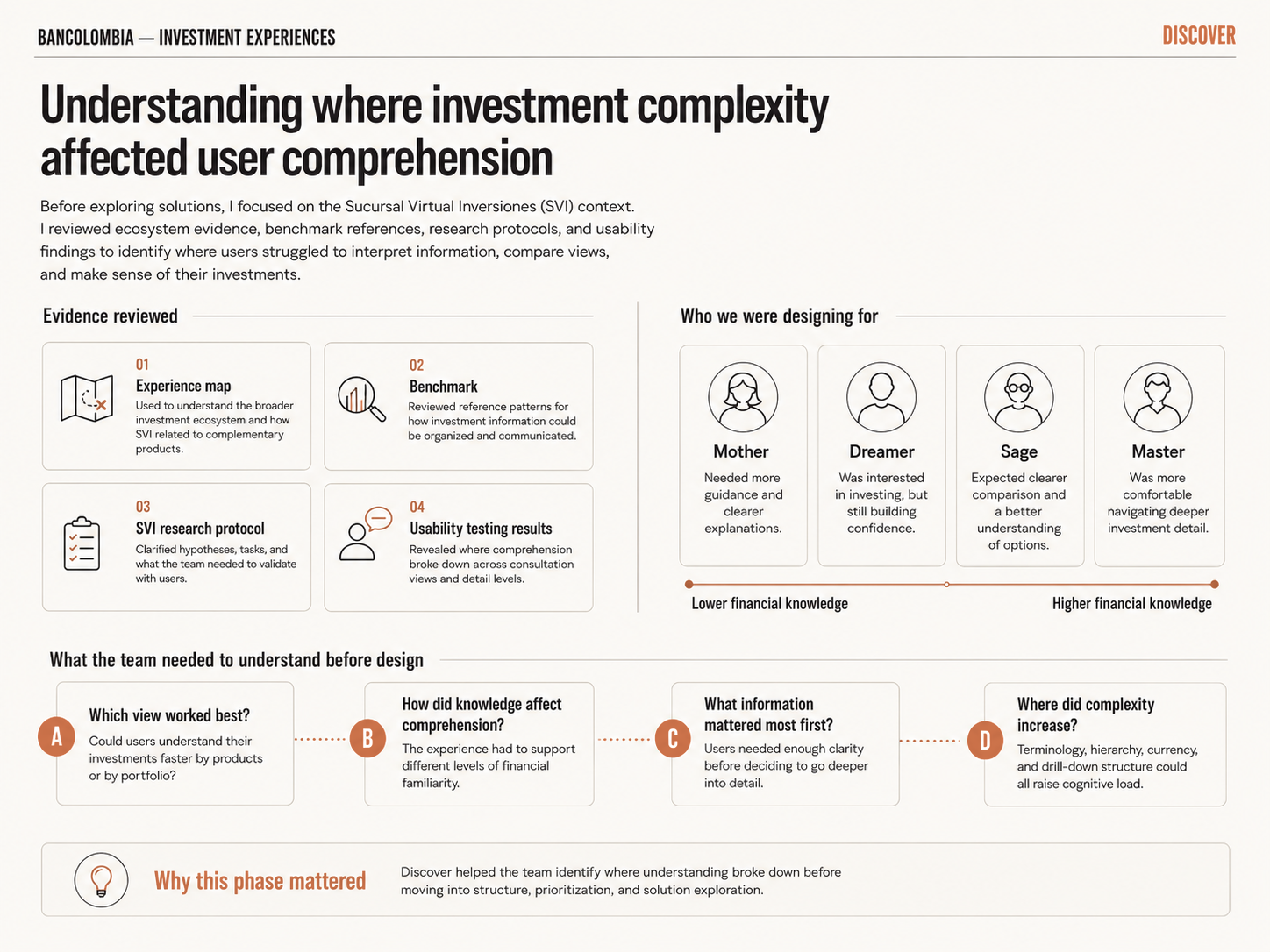
Discovery structure used to understand where investment product complexity could affect user comprehension and decision-making.
02 — Define
Turning investment complexity into clear flows
Then I translated the financial complexity into a UX direction that business, product, design, and development could review.
- Defined user flows for the investment tasks.
- Structured information architecture to reduce cognitive load.
- Prepared flow logic for validation and later high-fidelity design.
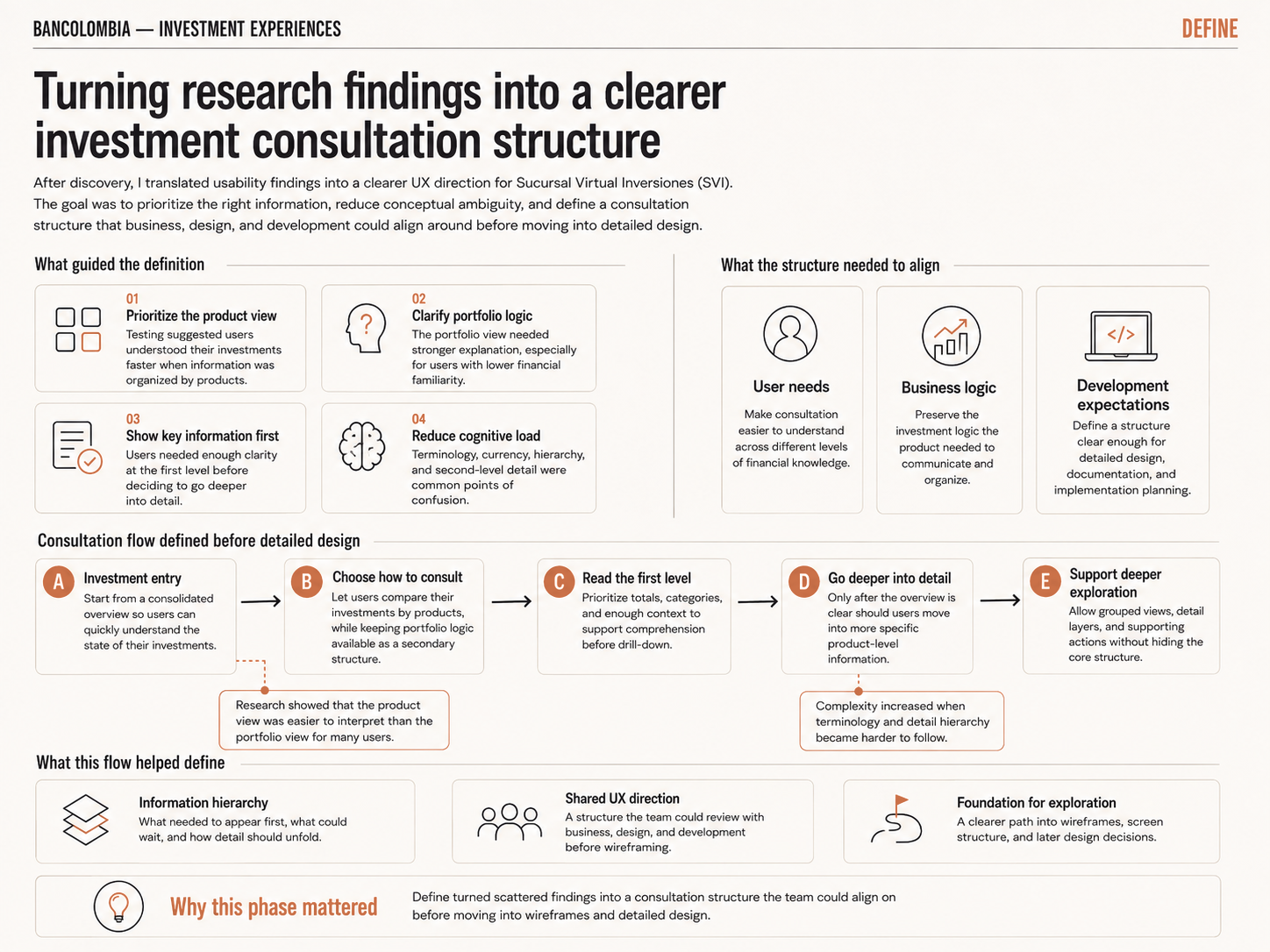
User flow used to align business logic, user needs, and development expectations before moving into detailed design.
03 — Develop
Exploring wireframes, prototypes, and validation materials
With the structure clear, I created wireframes, prototypes, and research materials: the idea was to make the experience tangible enough for stakeholders and users to react before committing to implementation.
- Built prototypes to communicate navigation, hierarchy, and interaction logic.
- Prepared the testing scripts and research artifacts, and ran usability testing and prototype validation with UserTesting.
- Collaborated with the Service Design team on building service blueprints and experience maps.
- Iterated on stakeholder feedback and validation activities.
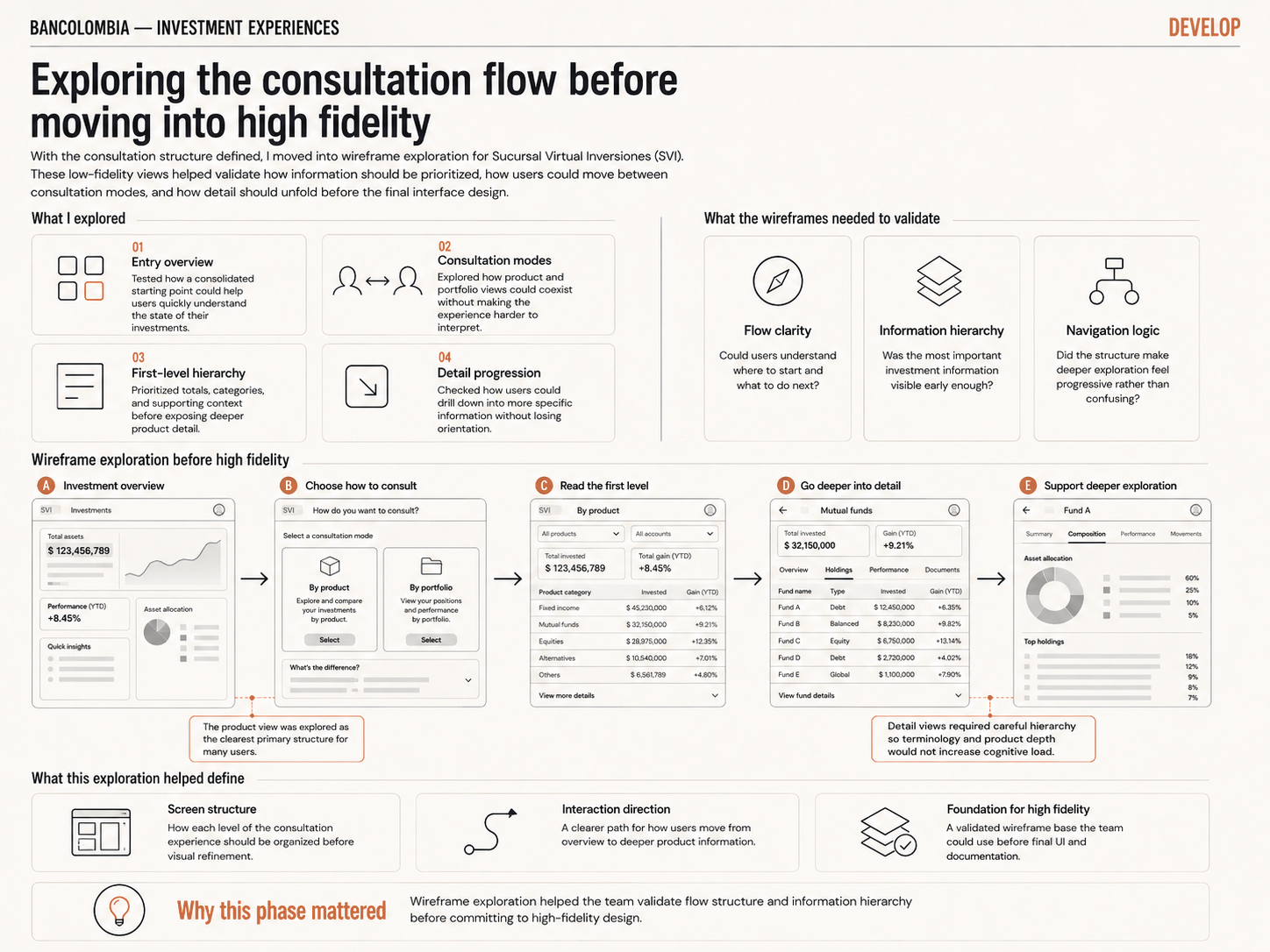
Wireframe exploration used to validate flow structure and information hierarchy before moving into high fidelity.
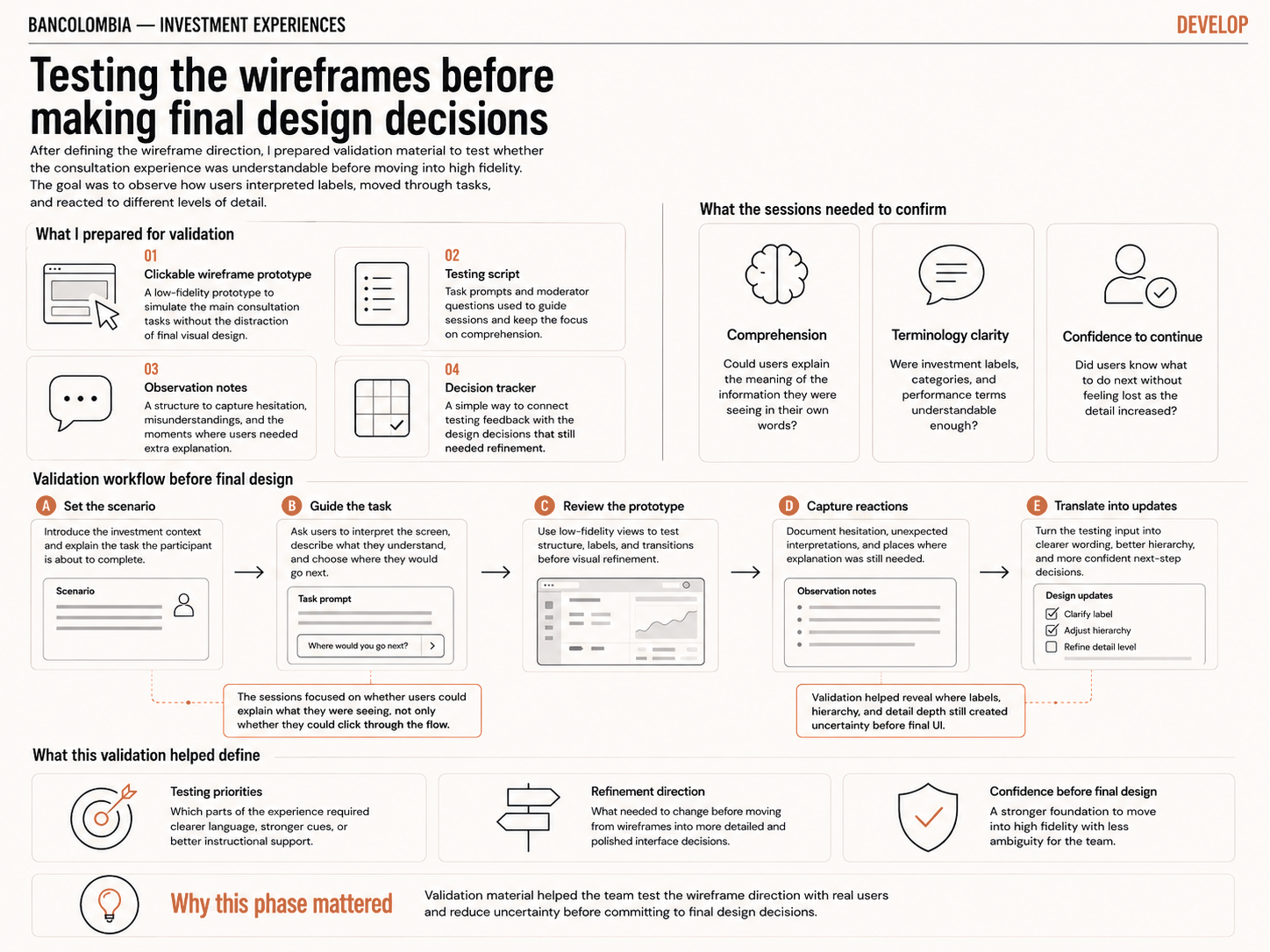
Validation material I prepared for user testing. It helped us reduce uncertainty before final design decisions.
04 — Deliver
Supporting final UX definition and development alignment
The deliverables (flows, information architecture, prototypes, and validation artifacts) helped stakeholders align and reached development with fewer doubts.
- Delivered user flows, wireframes, prototypes, and information architecture artifacts.
- Analyzed the test results and delivered the findings to the team.
- The Product Owner and the technical team approved each proposal first. With both approvals, it went to the VP of Investments, who decided whether it entered the work roadmap.
- Everything was documented so the team could keep building the investment Web and App. There was also a backlog of user stories for building what the business had already approved.
- Supported high-fidelity design based on UX direction.
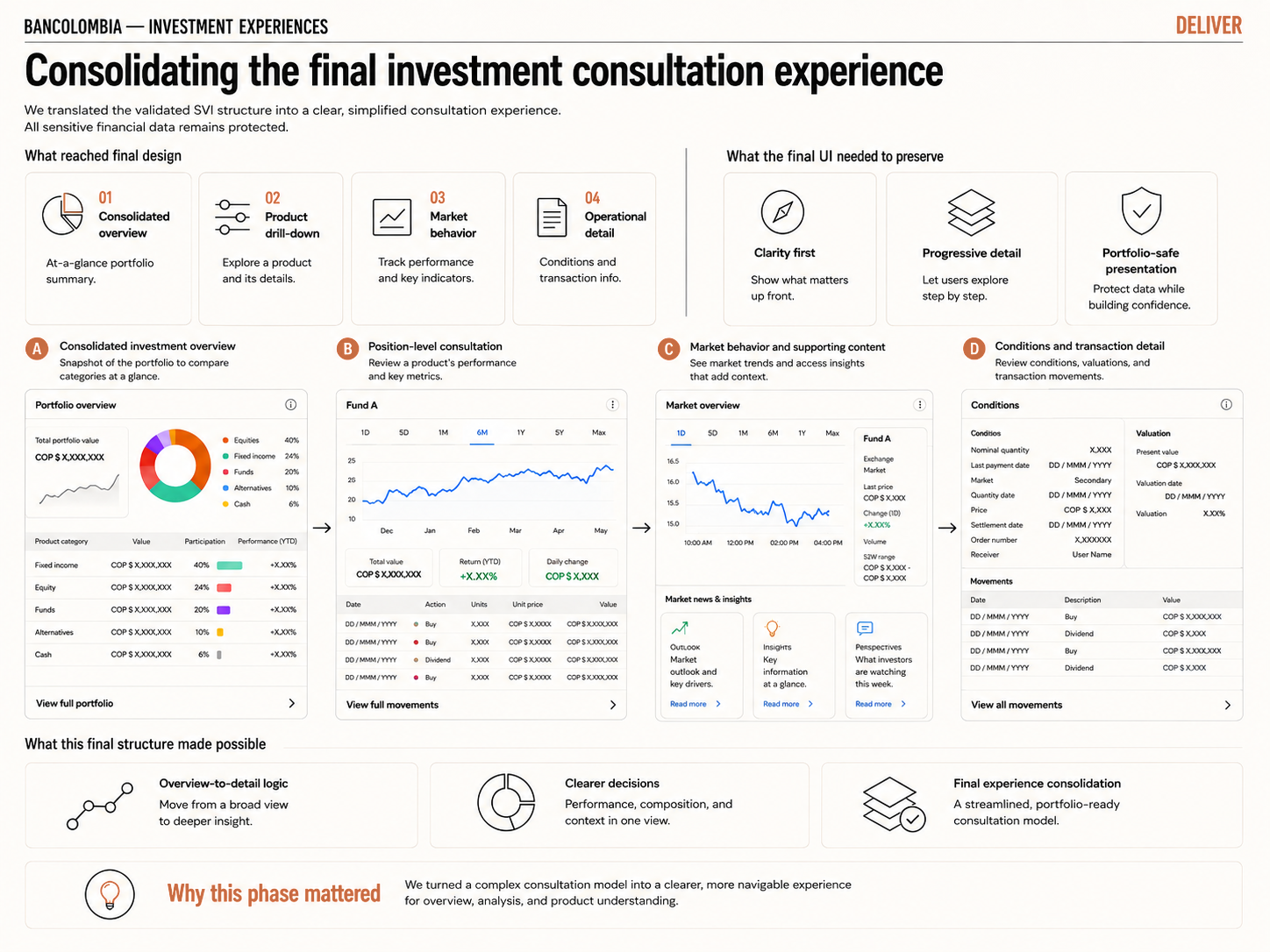
Final experience simplified for portfolio purposes to show structure without exposing sensitive financial information.
Before / after
Before
Complex financial information, difficult terminology, and flows that raised doubts for users and stakeholders.
After
Clear user flows, information architecture, and prototypes that improved understanding and alignment.
Final solution
The work focused on three improvements:
Clearer investment flows
User flows that made the financial journeys easier to understand and validate.
Stronger information architecture
I organized the investment information to reduce cognitive load and make the content more navigable.
Validation-ready UX artifacts
Wireframes, prototypes, and testing materials that supported stronger decisions before development.
Impact & results
User value
Investment experiences that are easier to understand and navigate.
Business value
Business, product, design, and development aligned around the same experience.
Product value
Financial logic translated into flows and prototypes ready for validation.
Team / process value
Experience decisions made tangible and easier to discuss before development.
Obstacles & trade-offs
Working in a regulated financial environment meant collaborating with legal and compliance so content and flows met the standards without losing clarity. The challenge was making the products understandable without losing their essential meaning.
- Translating complex financial products into clear user experiences.
- Handling sensitive financial information under confidentiality.
- Aligning multiple stakeholders around the same UX direction.
- Working with content where trust and precision were critical.
What I learned
Financial UX demands precision and trust: the goal is to structure complexity so users understand what matters, not to remove it.
- I learned to translate complex financial products into clearer digital flows.
- I improved how I plan and run validation with scripts, prototypes, and research.
- Information architecture is one of the strongest tools for removing ambiguity.
- I got comfortable working with sensitive information under confidentiality.
Looking back, this is a good example of how I work when I'm dropped into a domain I don't know well: slow down, structure the information carefully, build artifacts people can actually validate against, and use that to turn ambiguity into something the team can trust.
Stephanie Cacheo — Senior Product Designer / UX Lead